
Comparison between conventional mechanical freezing and cryogenic freezing with liquid nitrogen, with a focus on IQF tunnel and industrial best practices
htmlExecutive Summary
Texture degradation in strawberries after thawing is primarily caused by cellular damage induced by the formation and evolution of ice crystals. Slow freezing promotes the formation of larger crystals (often predominantly extracellular), which rupture cell membranes and walls, resulting in softening and drip loss during thawing.
Scientific literature consistently shows that:
- Increasing the freezing rate (faster freezing front)
- Maintaining strict storage temperature stability (limiting recrystallization)
are critical to preserving quality.
For strawberries intended to be thawed and consumed as whole pieces (not only for purées), the most balanced industrial solution is typically:
- IQF (Individual Quick Freezing) in a tunnel (fluidized bed / forced air)
- Combined with upstream best practices:
- pre-cooling (0–4 °C)
- surface drying
- single-layer feeding
- multi-zone thermal profile (crust freezing + hardening)
Cryogenic freezing with liquid nitrogen (LN₂, −196 °C) provides the highest freezing rates and can improve structural integrity, especially through instant crust formation that limits clumping and deformation.
However, cryogenic systems involve:
- Higher operating costs (LN₂ consumption)
- Strong safety requirements (oxygen deficiency risk)
- Dependence on gas logistics
Comparison of Freezing Technologies
Key Principle (applies to all methods)
Product quality after thawing depends on ice crystal morphology:
- Fast freezing → small crystals → better texture
- Slow freezing → large extracellular crystals → poor texture
For strawberries, studies show crystal sizes typically range from:
- ~60 to 390 µm, increasing away from the cooling surface
Main Technologies
1. IQF Tunnel (Mechanical – Fluidized Air)
Mechanism: Forced convection of very cold air (multi-zone)
Advantages:
- Best cost/quality balance
- Free-flowing product (if well singulated)
- High capacity
- Easy integration in industrial lines
Limitations:
- Sensitive to surface moisture (frost, clumping)
- Requires precise airflow and load control
Typical parameters:
- Air temperature: −35 to −45 °C
- Air velocity: ~5 m/s (up to >10 m/s for rapid freezing)
- Residence time: ~8–20 min (whole strawberries)
Expected result:
- Moderate-to-small crystals
- Good preservation if rapid crystallization zone crossing
2. Cryogenic Freezing – LN₂ Spray
Mechanism: Convective cooling via LN₂ evaporation
Advantages:
- Extremely fast freezing
- Excellent surface crusting
- Ideal for delicate or sticky products
- Compact equipment footprint
Limitations:
- High OPEX (LN₂ consumption)
- Safety constraints (ODH risk)
- Risk of over-freezing / thermal shock
3. Cryogenic Freezing – LN₂ Immersion
Mechanism: Direct contact with LN₂ bath
Advantages:
- Fastest freezing method
- Instant crust formation
- Excellent anti-clumping performance
- Ideal as pre-crusting step
Limitations:
- Risk of cracking (thermal shock)
- High LN₂ consumption
- Hygiene management required
4. Blast Freezing (Air Blast)
Mechanism: Conventional cold air convection
Advantages:
- Flexible
- Lower CAPEX
Limitations:
- Slow freezing → large crystals
- Risk of dehydration
- Not IQF (product blocks)
Typical parameters:
- Air: −35 to −45 °C
- Time: 12–48 hours
5. Plate Freezing (Contact Freezing)
Mechanism: Conduction via cold plates
Advantages:
- Energy efficient
- Low dehydration (if packaged)
Limitations:
- Not suitable for whole strawberries (compression damage)
Pre-Treatments and Upstream Optimization
Pre-Cooling
- Target pulp temperature: 0–4 °C
- Reduces thermal load and freezing time
- Limits condensation and frost formation
Washing & Drying
- Controlled washing (HACCP compliant)
- Critical: efficient surface drying
- Avoid free water → prevents ice bridges and clumping
Texture Treatments
Best-performing approaches:
- Calcium treatments (CaCl₂) → strengthens cell walls
- Calcium + PME (pectin methylesterase) → improved firmness
- Osmotic treatments (sugars / acids) → reduce free water
Not recommended:
- Blanching → damages structure and texture
IQF Process Control
Multi-Zone Freezing
- Zone 1: Crust freezing
- Rapid surface freezing
- Prevents sticking and deformation
- Zone 2: Hardening
- Core temperature reduction
- Target exit temperature ≤ −18 °C (often lower in practice)
Critical Operational Factors
- Proper singulation (key success factor)
- Uniform feeding (vibrating conveyors)
- Controlled airflow and agitation
- Minimal surface moisture
Hybrid Approach (Highly Relevant)
Widely used industrial configuration:
- Step 1: Cryogenic pre-crusting (LN₂ spray or dip)
- Step 2: Mechanical IQF finishing
Benefits:
- Reduced clumping
- Improved structure
- Increased line capacity
Quality Control Metrics
Key KPIs:
- Drip loss (%)
- Texture (firmness)
- Color (CIELAB, anthocyanins)
- Microstructure (crystal size)
- Microbiological safety
Important: Thawing method has major impact on results and must be standardized.
Cost, Energy & Scalability
General Trends
- IQF mechanical:
- Best for large volumes
- Lower operating cost (electricity)
- Cryogenic:
- Best for high-value / delicate products
- Flexible and fast deployment
- Higher operating cost
- Hybrid:
- Strong compromise
- Often optimal for premium IQF strawberries
Safety Considerations (LN₂)
Main risks:
- Oxygen deficiency (anoxia)
- Cryogenic burns
- Pressure hazards
Required measures:
- Ventilation and extraction
- Oxygen monitoring (alarm ~19.5%)
- Operator training
- Compliance with pressure equipment regulations
Process Flow (Simplified)
Reception → sorting → washing → draining & drying → pre-cooling (0–4 °C) → singulation → freezing:
- IQF tunnel (crust freezing → hardening)
- OR hybrid (LN₂ pre-crusting → mechanical finishing)
- OR full cryogenic tunnel
→ packaging → storage ≤ −18 °C → quality control
Pragmatic Conclusion
- For high volume + cost efficiency → mechanical IQF tunnel is the standard
- For maximum structural integrity / difficult products → hybrid or cryogenic solutions
- In all cases:
- upstream handling (drying, pre-cooling, sorting)
- and freezing rate
Mr Khaled Nablsy Export Manager of Indagro for Food & Agricultural Industries [email protected]
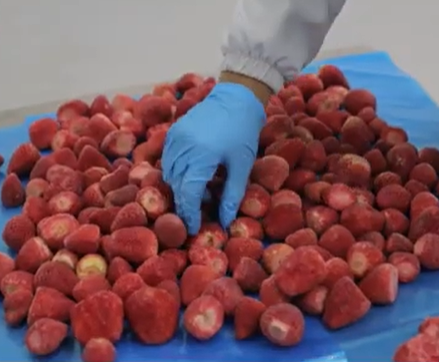
shares this video to illustrate some of the points of mechanical freezing from ELBOUSHI FOODS FACTORY
- high velocity Air-Knives post wash this removes all “free water” before freezing preventing clumping and “snowing”
- The Zone: tunnel uses a Multi-Zone approach the first zone creates a thermal Shock (Crust freezing) that locks the fruit’s structure instantly without needing Nitrogen.
- Cell Integrity: This rapid freezing ensures micro crystal formation keeping Drip Loss at a minimum and preserving the firmness that Rauch or Darbo require